
Women Can Run Marathons
Thu, 01 Jun 2017 00:00
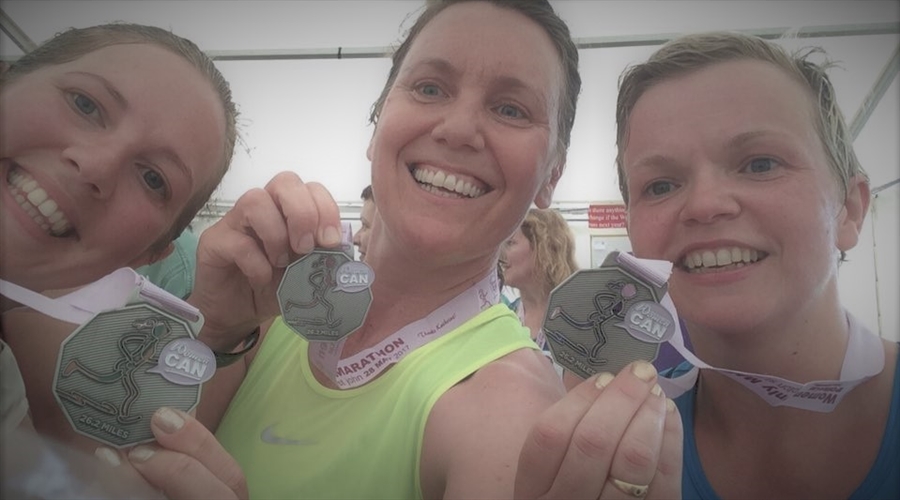
On Sunday 28th May 2017 I ran my first marathon. I can’t say at this stage whether it will be the first of many or a one-off. What I can tell you is that I honestly enjoyed every minute of it – even the really tough ones. But maybe that’s because of the particular marathon I chose to take on, and the people I did it with.
I wasn’t considering running a marathon this year. To be honest, I couldn’t imagine ever doing it. I’ve done three half-marathons and always found the final three miles tough. Ten miles, for me, was a lovely distance. More than that always felt hard, and I’d generally only go above 10 miles for a nice medal! In January I went to a marathon workshop with Mara Yamauchi, organised by UK Athletics. Mara was speaking about her marathon running career and about coaching marathon runners. It was an interesting talk and I picked up plenty of useful information for coaching marathon and half-marathon athletes, but as far as doing one myself was concerned it made me feel even less inclined to do it – the training, the nutrition, it all sounded like very hard work!
But then, a couple of days after the workshop, one of my lovely runners, Emma, who I was coaching for the Bath Half lent me a book called “Your Pace or Mine?: What Running Taught Me About Life, Laughter and Coming Last” by Lisa Jackson. It was a very different approach to running a marathon. Let’s face it… even if I follow Mara Yamauchi’s training plans and instructions to the letter I’m never going to run a sub-4 hour marathon, but chatting, singing, dressing up, sharing snacks and hugs, and making it to the finish before the cut-off time is an approach to marathon running that I can fully embrace!
The final piece of the puzzle was when a friend said she was interested in running a marathon down in Devon – a hilly, off-road marathon only open to women called Women Can. Messages and comments flew back and forth on social media and by the end of the day five of us had signed up!
Fitting in training meant juggling it around families, jobs, holidays and all the other things that mums have to do, but three of us – Jo, Kerry and me – managed to do most of our long runs together. They tended to involve lots of chatting, dragging ourselves up some of Bath’s epic hills, and refuelling with coffee, cake and bacon sandwiches – the Sainsbury’s café between Jo and Kerry’s houses will see a dip in profits now!
We each had a training plan – we didn’t stick to it perfectly, but we did our best. Our last long run together was 20 miles long with 2,000 feet of climbing. At 15 miles we were all feeling good, but then we came to a very long steep climb. It completely messed up our rhythm and we all struggled to regain any momentum after that. The last two miles were long and painful and nobody spoke (a rare occurrence). To me it felt a bit serious then. In 4 weeks’ time we would be running another 6 miles of distance and climbing an additional 1,000 feet of elevation. That seemed like a huge amount more.
Anyway, time marched on and we began to taper – gradually reducing the length of our runs to ensure we had fresh legs and plenty of energy on the day – and to make proper plans for the event. We met up last Friday with cake and notepads. We were all nervous by now, and feeling jittery without our usual outlet of running. Kerry and I were camping together at the playing fields where the marathon started and finished. Jo’s family were going down with her, staying in another village, so we finalised our plans to meet, cross-checked our packing lists and had a final moment of wondering what on earth we were doing!
At this point it might be good to explain why a women only marathon was happening at all. Fifty years ago women were not permitted to run marathons. We were considered too delicate. Our bodies, they said, just weren’t built for long distance running. Terrible things would happen! But in the 1960s a few women began to challenge this, and in 1967 Kathrine Switzer entered the Boston Marathon wearing an official number. She was almost dragged off the course by the race director, but her fellow athletes, her coach and her boyfriend protected her and she completed the race. In the years following she researched and campaigned, and 17 years after that first marathon run the Women’s Marathon debuted at the 1984 Los Angeles Olympics. It’s an inspiring story of a huge change which has come about in our lifetimes, and we are lucky now that in the UK our gender no longer disqualifies us from running a marathon (if we want to), or entering any other sporting event.
Fast forward 49 years and a woman called Jo Earlam, a runner from Devon, came up with a plan to mark the 50th anniversary of Kathrine’s run and to raise money and awareness for Free to Run, a charity which helps women and girls in countries where running is still not accessible to them. A celebration of the fact that, in 2017, women can.
So that’s how it happened that at 8am on a cloudy Sunday morning, on a playing field in the tiny Devon village of Tipton St John, Kerry and I sat just outside our tent and watched the Nordic Walkers set off at the start of their marathon. They had a one hour head start, but all being well we would overtake most of them on our way round. We finished our porridge, filled our running vests with water, put our snacks into various pockets, pinned on our numbers, laced up our trail shoes. All the preparation had been done and all that was left was to run 26 miles 385 yards. We were nervous – dithering about whether to wear sunglasses or hats or both. We sprayed on some sunscreen and dabbed Vaseline on the bits that might chafe. Jo and her husband, Miles, arrived and we handed over extra snacks to him with instructions on what to give us and when – we had two rendezvous points prearranged. We met up briefly with Janice who had signed up at the same time as us way back in January in that flurry of madcap enthusiasm, then Kerry and I went for a final wee by which time the warm up had started and within a few minutes we were underway, taking our first strides of the first mile.
The route curved round the playing field, across the road and onto the path alongside the River Otter. There were poppies and yellow rapeseed and some little blue flowers that none of us could name. Underfoot was sand and gravel, then narrow grass paths. We chatted to other runners and enjoyed the first couple of miles of gentle downhill. The initial mile or two of any run is tough. Your legs feel heavy as your body struggles to provide the additional oxygen that your muscles are demanding. But you know that after a bit your breathing and heart rate will catch up with demand and you’ll be into a comfortable rhythm.
We had done some back-of-an-envelope calculations and based on our training runs the marathon was going to burn through upwards of 3,000 calories. Our plan was to eat something – a gel or a snack bar – about every 30 minutes throughout the whole race. We also needed to drink little and often. That gave us a couple of things to think about and do while we kept on running, ticking off the miles. I’m a great believer in mind over matter. Training can only get you so far – so much of running is mental. I suggested that we count the miles upwards to 13 and then down again back to zero. Kerry and Jo were up for a bit of mental arithmetic and amateur psychology so we celebrated every mile marker with a “woohoo” – and an extra big one for 7 miles – more than half way to half way. Jo’s watch was set to kilometres so she gave us a heads-up every time we did another parkrun – “four down, only another four-and-a-bit to go” sounds much better than “we’re not even half way there”!
The hills had been well advertised: 3,000 feet of climbing – the equivalent of a mountain – because women take on and conquer mountains in life, so it was fitting that they should do it in this marathon. For all the hill training we’d done around Bath – and Bath is a hilly city – we hadn’t got close to 3,000 feet. What we had done was to learn quite a bit about running up big hills. Possibly the most important thing we’d learned was when to walk and when not to. The job of “declaring a hill” fell to me and I was determined to be strict. In our experience the key with hills is to judge, almost as soon as you start running up it, what kind of hill you’re on. Short and sharp or long and gradual are both runnable, but (for most people) you’ll eventually encounter a hill that needs some walking. If you leave it too long to start walking you’ll barely have the breath to put one foot in front of the other, but if you start walking early you can stride out and go faster than if you were running. Plus you arrive at the top ready to run again immediately. Well, that’s what we found anyway. So as we got closer to the coast and the first of the inclines began I could be heard shouting “this is not a hill”: code for “no walking yet”, without actually mentioning walking and planting the seed of self-doubt.
The unrunnable hills did come eventually, on the stretch of coastal path from the mouth of the River Otter to the cliffs above Ladram Bay, but the views were worth it – a cliché, but so true! We made sure to turn round a full 360 degrees every so often to admire the landscape and seascape from all angles. Near the top we were surprised by Kerry’s dad and step mum who had travelled from Hampshire to support her. Then the route plunged back down to sea level and the lovely town of Sidmouth where we ran through the bank holiday crowds, past ice cream kiosks and shops selling beach toys, to meet Miles on the esplanade. He had snacks to replenish our stores and a big hug for Jo.
It was lovely to be over half way and to start counting down through the miles. Soon after we left Sidmouth and turned away from the coast we encountered the start of the second big hill. And boy was it a big one. We climbed, at a variety of gradients, for about four miles. Some stretches we ran, some were hands-on-hips trudging. But it was shady, the views as we climbed were magnificent, the terrain underfoot ranged from soft, bouncy grass to rocky paths. For much of it we were running with someone in a Sidmouth Running Club vest. She knew this part of the route and shared her knowledge so we knew that when we got to the top there was a stretch of flattish running with a few undulations before the much anticipated long downhill. The marshals, indeed all the supporters we saw, were lovely. Where the route crossed roads the motorists clapped us. Some of the marshals we’d seen earlier in the day popped up again having moved stations and we greeted them like old friends. By now we’d got a reputation as the Smiley Bath Ladies.
Writing this now some parts of the race are blurry. I didn’t hit the wall at any point, and I’d been in much worse mental fogs on shorter training runs, but I hadn’t quite managed to keep to the plan with refuelling. I was okay, but the details are a little hazy. At what point was it that we decided to pass the time by challenging each other, and our fellow runners, to give the correct name for baby animals? I still maintain that a baby otter should be an otterling – it isn’t – we googled. However, for all my confusion I did know that what goes up must come down – thank goodness! The long descent took less time than the climb had and it was lovely to start ticking off the miles a bit more quickly. The 20 mile marker was both a welcome sight and a daunting one. Welcome because it meant we only had 6.2 miles to go. 10 kilometres. Two parkruns. Daunting because everything beyond this was unknown. Further than we’d run in training. But actually I remember feeling excited. Going into the unknown is something I enjoy!
Finally we reached the bottom of the valley and the outskirts of Ottery St Mary. I’m not sure if it was hysteria beginning to take hold just a bit, or a stroke of motivational genius, but we hit on the idea to do a bit of singing. For some reason we chose songs from the musicals and so we entered Ottery St Mary enthusiastically chorusing “Doe, a deer, a female deer”. Far, a long, long way to run seemed very apt. This was our final rendezvous point with Miles. He had sweets and flat cola for us, but none of us could face eating anything. Instead of picking up anything else we lightened our load, and ditched our bags and hats to run the final three miles unencumbered. We didn’t know if it would be the right decision – this was unknown territory for all of us. It felt like heaven to cast off our burdens and set off again, along the banks of the River Otter, slightly downhill. I wouldn’t go so far as to say we were flying, but we could sense that the end was in reach. We were going to do it!
As we got onto the finishing straight we held hands, picked up speed and ran as fast as we could, arms raised, over the line! My watch said 26.3 miles, Kerry’s said 26.8, but Jo’s was only on 41.9 kilometres – 300 metres short of a full marathon. She went for a quick lap of the field to get up to distance, and then it was celebration time! We met up with Janice. Her whole family had surprised her at the finish, so she couldn’t stay to celebrate with us. I felt distracted and spaced out. Elated at having finished, and bizarrely preoccupied with the promised cup of tea for all finishers. I’m not even sure what I said to Janice! Hopefully “well done” was in there somewhere!
Medals round our necks and tea in hand we made our wobbly way back towards the tent. Miles appeared. There were plastic cups of prosecco, celebratory selfies, the best pizza ever, some stretches and Strava uploading, another cup of tea. We had planned to cool off in a wild swimming spot a couple of hundred metres back up the river, but it was chilly with a spot or two of rain. I opted for a scaldingly hot shower in the pavilion instead.
Maybe there should have been fireworks and an epic party to celebrate our achievement. There wasn’t. There was a tent and a forecast of rain. We had planned to stay that night, mainly because we weren’t sure whether we’d be in any fit state to pack up and travel home, but we felt okay. With the prospect of going home to a bubble bath and a comfy bed versus a stormy night under canvas and packing up a soggy tent in the rain tomorrow morning we went for the first option.
In some ways it seemed like a bit of an anti-climax to go home to normal life, but maybe that’s the point. We’re actually just ordinary women with children and responsibilities and all the things that women have to think about. When I consider my achievement at having run my first marathon I get a warm fuzzy feeling. It makes me smile. Every time my boys find my medal they come and hang it round my neck. “You won that, mummy!”, one of them said. I did. I feel proud. I’m touched by all the lovely comments we’ve had – who wouldn’t enjoy being called inspirational? – the kudos, the likes, the retweets (especially the ones from Kathrine Switzer… THE Kathrine Switzer!). But… and here’s the cheesy ending… that 26.2 miles was hard, no doubt about it, but it was by no means the hardest thing I’ve ever done. Nor was it my greatest achievement or my proudest moment. The hardest moments and the proudest moments never have a medal at the end of them.